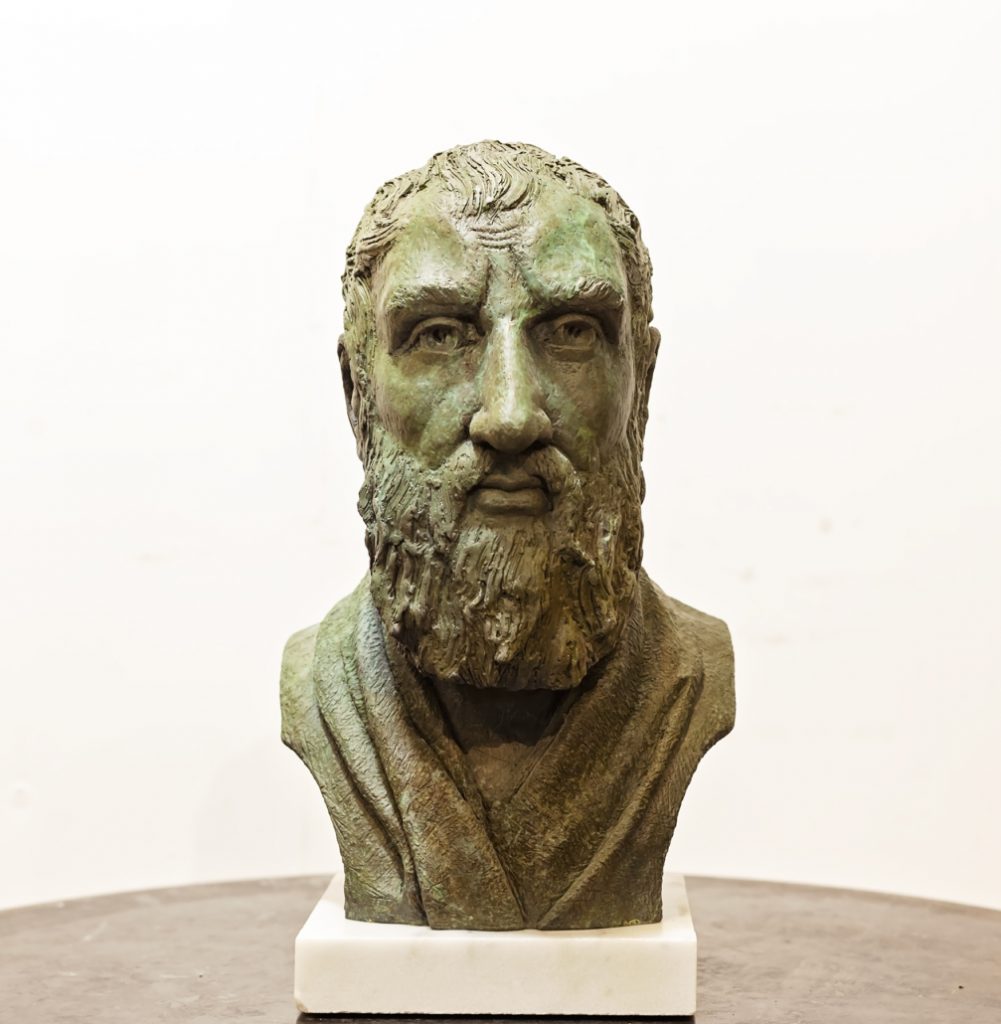
Redemption of the Firstborn (Parsha Bo Ex. 10:1-13:16)

This weeks (1/23/21) Torah Parsha is Parsha Bo (Exodus 10:1-13:16). In his work The Sacrifices of Abel and Cain, Philo of Alexandria gives a very insightful midrash on Exodus 13:11-16 dealing with the redemption of the Firstborn.

Lets begin by looking at Exodus 13:11-16:

[11] And it shall be when the LORD shall bring thee into the land of the Canaanites, as he sware unto thee and to thy fathers, and shall give it thee,
[12] That thou shalt set apart unto the LORD all that openeth the matrix, and every firstling that cometh of a beast which thou hast; the males shall be the LORD’s.
[13] And every firstling of an ass thou shalt redeem with a lamb; and if thou wilt not redeem it, then thou shalt break his neck: and all the firstborn of man among thy children shalt thou redeem.
[14] And it shall be when thy son asketh thee in time to come, saying, What is this? that thou shalt say unto him, By strength of hand the LORD brought us out from Egypt, from the house of bondage:
[15] And it came to pass, when Pharaoh would hardly let us go, that the LORD slew all the firstborn in the land of Egypt, both the firstborn of man, and the firstborn of beast: therefore I sacrifice to the LORD all that openeth the matrix, being males; but all the firstborn of my children I redeem.
[16] And it shall be for a token upon thine hand, and for frontlets between thine eyes: for by strength of hand the LORD brought us forth out of Egypt.
(Ex. 13:11-26 KJV)

Philo understands the “Land of the Caananites” to represent “fluctuating reason” while the “firstborn” represents Abel:

(89) Now the commandment is as follows: “And it shall be,” say the scriptures, “when God shall bring thee forth into the land of the Canaanites, in the manner which he swore to thy fathers, and shall give it to thee, that thou shalt set apart unto the Lord all that openeth the womb of all thy flocks, and of all the beasts which thou hast, and shalt set apart all the males for the Lord. Every offspring of an ass that openeth the womb shalt thou exchange for a sheep; and if thou dost not exchange it thou shall redeem it with Money.”For that which openeth the wound is Abel, that is to say, a gift, the first-born, and you must examine how and when it is to be offered up; (90) now the most suitable time is when God shall lead thee into fluctuating reason, that is to say, into the land of the Canaanites, not in any chance manner, but in the manner in which he himself swore that he would; not in order that being tossed about hither and thither in the surf and tempest and heavy waves, you may be deprived of all rest or stability, but that having escaped from such agitation you may enjoy fine weather and a calm, and reaching virtue as a place of refuge, or port, or harbour of safety for ships, may lie in safety and steadiness.
(Sacrifices of Abel and Cain 89-90)

The first century Jewish writer Philo of Alexandria understood the conflict between Cain and Able as symbolic of the conflict within man. In his commentary to the story of the offerings made by Cain and Abel he gives is a very good illustration of this conflict:

(2) It happens then, that there are two opinions contrary to and at variance with one another; the one of which commits everything to the mind as the leader of all reasoning, or feeling, or moving, or being stationary; and the other, attributing to God all the consequent work of creation as his own. Now the symbol of the former of these is Cain, which name, being interpreted means, “possession,” from his appearing to possess all things; and the symbol of the other is Abel; for this name, being interpreted, means “referring to God.” (3) Now both these opinions were brought forth by one soul. But it follows of necessity that as soon as they were born they must have been separated; for it was impossible for enemies to dwell together for ever. Until then the soul brought forth the God-loving doctrine Abel, the self-loving Cain dwelt with her. But when she brought forth Abel, or unanimity with God, she abandoned unanimity with that mind which was wise in its own conceit.  
(On the Birth of Abel and the Sacrifices Offered by Him and His Brother Cain 2-3)

Philio (whose Bible was the Greek Septuagint) interprets “Cain” to mean “possession,” which is in keeping with the Hebrew verb KANA “to own, to possess, to acquire”.  He interprets Abel to mean “referring to God” probably understanding Abel (Havel in Hebrew) to be derived from HAV EL “to give [to] El”.

Philo sees Cain as representing the animal soul and the evil inclination which is completely self-centered and only desires to acquire, own and possess for self the pleasures of this world.  On the other hand Abel represents the divine soul and the good inclination, which only wishes to serve YHWH.

Elsewhere Philo writes:

And as Philo of Alexandria concluded:

“For these passions are the causes of all good and of all evil; of good when they submit to the authority of dominant reason, and of evil when they break out of bounds and scorn all government and restraint.”
(Life of Moses 1; VI, 26)

And as we read in 4th Maccabees:

21 Now when Elohim fashioned man, he planted in him emotions and inclinations,
22 but at the same time he enthroned the mind among the senses as a sacred governor over them all.
23 To the mind he gave the Torah; and one who lives subject to this will rule a kingdom that is temperate, just, good, and courageous.
(4Macc. 2:21-23)

Philo interprets the reference to the redemption of the “male” firstborn as tied to the idea that the female psychology is more prone than the male psychology, towards uncontrolled emotions. Philo, who writes in the first century, and not with today’s political correctness, writes:

(102) But it is most entirely in accordance with nature “to sacrifice the males of every creature that openeth the womb, to God.”For as nature has given to women the womb, as the part most excellently adapted for the generation of animals, so also for the production of things she has placed a power in the soul, by means of which the mind conceives and is in travail, and brings forth many things. (103) But of the ideas which are brought forth by the mind, some are male and some female, as in the case of animals. Now the female offspring of the soul are wickedness and passion, by which we are made effeminate in every one of our pursuits; but a healthy state of the passions and virtue is male, by which we are excited and invigorated. Now of these, whatever belongs to the fellowship of men must be attributed to God, and everything that relates to the similarity to women must be imputed to one’s self, on which account the command was delivered, “Of everything which openeth the womb the males belong to the Lord.”
(Sacrifices of Abel and Cain 102-103)

Philo concludes that the firstborn are redeemed in the Land of the Caanonites (fluctuation of reason) when “when the most dominant parts of blind passion are destroyed“:

(134) “But in the day,” says God, “on which I smote the first-born in the land of Egypt, I consecrated to myself all the first-born of Israel.” And he says this not to lead us to suppose that at the time when Egypt was stricken with this mighty blow by the destruction of all its first-born, the first-born of Israel all became holy, but because both in former times, and now, and hereafter, and for ever, this naturally happens in the case of the soul, that when the most dominant parts of blind passion are destroyed, then the elder and most honourable offspring of God, who sees everything with a piercing sight, becomes holy;
(Sacrifices of Abel and Cain 134)

If you would like to see more of these weekly Stoic Torah studies, please support this work of restoration of Hebraic Stoicism by donating by Paypal to donations@wnae.org

Providence and Pharaoh (Parsha Va’era Ex. 6:2-9:35)

This coming week’s (Jan. 16th; 2021) Torah Parsha (Parsha Sh’mot; Ex. 1:1-6:1) deals with a subject very important to Stoicism: Providence. In this weeks Parsha we read:

[12] And YHWH hardened the heart of Pharaoh, and he hearkened not unto them; as YHWH had spoken unto Moses.
[13] And YHWH said unto Moses, Rise up early in the morning, and stand before Pharaoh, and say unto him, Thus says the YHWH Elohim of the Hebrews, Let my people go, that they may serve me.
[14] For I will at this time send all my plagues upon your heart, and upon your servants, and upon your people; that you may know that there is none like me in all the earth.
[15] For now I will stretch out my hand, that I may smite you and your people with pestilence; and you shall be cut off from the earth.
[16] And in very deed for this cause have I raised you up, for to show in you my power; and that my name may be declared throughout all the earth.
[17] As yet exalt you yourself against my people, that you wilt not let them go?
(Ex. 9:12=17)

In his foundational book On Creation, the first Century Jewish philosopher Philo of Alexandria, concludes that a created universe, leads to the the corollary of the concept of “providence”. Philo writes:

And those who describe it [the universe] as being uncreated, do, without being aware of it, cut off the most useful and necessary of all the qualities which tend to produce piety, namely, providence: (10) for reason proves that the father and creator has a care for that which has been created; for a father is anxious for the life of his children, and a workman aims at the duration of his works, and employs every device imaginable to ward off everything that is pernicious or injurious, and is desirous by every means in his power to provide everything which is useful or profitable for them. But with regard to that which has not been created, there is no feeling of interest as if it were his own in the breast of him who has not created it. (11) It is then a pernicious doctrine, and one for which no one should contend, to establish a system in this world, such as anarchy is in a city, so that it should have no superintendant, or regulator, or judge, by whom everything must be managed and governed.
(Philo; On Creation 9b-11)

And later Philo concludes:

The fifth lesson that Moses teaches us is, that God exerts his providence for the benefit of the world. For it follows of necessity that the Creator must always care for that which he has created, just as parents do also care for their children.
(Philo; On Creation 171b-172a)

By “providence” Philo means that the Creator has a plan. Providence, in this sense, is closely tied to the concepts of natural law and the logos, about which I have previously blogged. Providence, is the idea that there is a rational mind, and therefor a plan, that is permeating the universe.

On the other hand, this weeks parsha also says that Pharaoh hardened his own heart:

But when Pharaoh saw that there was respite, he hardened his heart, and hearkened not unto them; as YHWH had said. (Ex. 8:15)

And Pharaoh hardened his heart at this time also, neither would he let the people go. (Ex. 8:32)

How can this be?

This brings us to the Hebraic Stoic understanding of Genesis 2:7, which I also blogged about recently.

And YHWH Elohim formed (YETZER) man of the dust of the ground,
and breathed into his nostrils the breath (NISH’MAT) of life;
and man became a living soul (NEFESH).
(Gen. 2:7)

The Wisdom of Ben Sira says of this verse:

It was He who created man in the beginning.
And He left him in the power of his own freewill (Heb: YETZER).
If you will, you can keep the commandments,

and to act faithfully is a matter of your own choice.
He has placed before you fire and water:
Stretch out your hand for whichever you wish.
 (Sira 15:14-16)

In the ancient Hebraic Stoic work, 4Maccabees (also known as On the Supremacy of Reason) we read concerning this verse:

21 Now when Elohim fashioned man, he planted in him emotions and inclinations,
22 but at the same time he enthroned the mind among the senses as a sacred governor over them all.
23 To the mind he gave the Torah; and one who lives subject to this will rule a kingdom that is temperate, just, good, and courageous.
(4Macc. 2:21-23)

And as Philo of Alexandria concluded:

“For these passions are the causes of all good and of all evil; of good when they submit to the authority of dominant reason, and of evil when they break out of bounds and scorn all government and restraint.”
(Life of Moses 1; VI, 26)

The neshoma that Elohim breathed into us, is a spark of the Logos. As Philo wrote:

There are two several parts of which we consist, the soul and the body; now the body is made of earth, but the soul consists of air, being a fragment of the Divinity, for “God breathed into man’s face the breath of life, and man became a living Soul.”(Gen. 2:7) It is therefore quite consistent with reason to say that the body which was fashioned out of the earth has nourishment which the earth gives forth akin to the matter of which it is composed; but the soul, inasmuch as it is a portion of the ethereal nature, is supported by nourishment which is ethereal and divine, for it is nourished on knowledge, and not on meat or drink, which the body requires. (Allegorical Interpretation, III, 161)

He does well here to attribute the flow of blood to the mass of flesh, combining two things appropriate to one another; but the essence of the mind he has not made to depend on any created thing, but has represented it as breathed into man by God from above. For, says Moses, “The Creator of the universe breathed into his face the breath of life, and man became a living Soul,” (Gen. 2:7) who also, it is recorded, was fashioned after the image of the Creator. (Who is the Heir of Divine Things? 56)

For among created things, the heaven is holy in the world, in accordance with which body, the imperishable and indestructible natures revolve; and in man the mind is holy, being a sort of fragment of the Deity, and especially according to the statement of Moses, who says, “God breathed into his face the breath of life, and man became a living Soul.”(Gen. 2:7). (On Dreams 1, 34)

The Hebraic Stoics understood this to mean that man had a “freewill” (yetzer) in that he can choose either to be guided by his emotions or to be guided by his rational mind, the fragment of the logos within him.

In other words, the only thing a man truly controls, is what he thinks, and how he chooses to feel. We cannot control what happens in the universe, we can only control what we choose to think about it.

By choosing to be guided by the rational mind rather than the emotions, a man is choosing to live in harmony with nature, the logos which guides nature and in harmony with providence which results from the logos guiding nature. This is why Philo writes:

the law corresponds to the world and the world to the law, and that a man who is obedient to the law, being, by so doing, a citizen of the world, arranges his actions with reference to the intention of nature, in harmony with which the whole universal world is regulated. (Philo; On Creation 3)

Or as he states elsewhere:

… the man who adhered to these laws, and clung closely to a connection with and obedience to nature, would live in a manner corresponding to the arrangement of the universe with a perfect harmony and union, between his words and his actions and between his actions and his words.
(On the Life of Moses 2, 48)

We can either live in harmony with providence, choosing to be guided by our rational minds, the fragment of the logos within us, or we can choose to be resist providence by being guided by our emotions. Neither choice will change those things which we cannot control, but the other path will lead to a peace of mind and happiness, even in the worst of circumstances. (This does not mean that we cannot, within the bounds of providence, potentially influence external events by our actions, but that is not actual control. In much the same way, one can influence an election thru campaign work and voting, but cannot control the ultimate outcome of the election.)

The statements that YHWH hardened Pharaoh’s heart is of a common Hebrew idiom in which an active verb is used to express not the doing of a thing, but permission to do it. Another example of this idiom is found in Jer. 4:10:

Then said I: ‘Ah, Adonai YHWH! surely
You have greatly deceived this people and
Yerushalayim, saying: You shall have peace;
whereas the sword reaches unto the soul.’
(Jer. 4:10 HRV)

Meaning not that YHWH deceived them but that he ALLOWED them to be deceived. (other examples of this idiom: Mt. 6:13a; 2Thes. 2:11; Rom. 1:24-26; Zech. 1:10b).

In the case of Pharaoh we have a man who who hardened his own heart (Ex. 8:11, 15, 28; 9:7). Elohim had the sovereign right to allow Pharaoh to harden his own heart of his own freewill. This concept is also taught in the Talmud:

In the way in which a man wishes to walk he is guided.
(b.Mak. 10b)

If one goes to defile himself, openings are made for him;
and if he goes to purify himself, help is afforded him.
(b.Shabb. 104a)

If a man defiles himself a little, he becomes much defiled:
[if he defile himself] below, he becomes defiled from above;
if he defile himself in this world,
he becomes defiled in the world to come.
Our Rabbis taught: Sanctify yourselves,
therefore, and be ye holy:
If a man sanctify himself a little,
he becomes much sanctified.
[If he sanctify himself] below,
he becomes sanctified from above;
if he sanctify himself in this world,
he becomes sanctified in the world to come.
(b.Yoma 39a)

If a man resists the providence of Elohim, he is like a dog on a long leash, tied to a moving cart. He can make his own decisions about where he wants to go, and in the short term, he may or may not be able to enact those decisions, but if he is resisting the direction of the cart, he will not find himself happy, and will eventually find himself dragged by the cart, in a direction he did not wish to go.

For a more detailed discussion of this topic, see my recent blog Providence in Hebraic Stoicism

This is the second of what may be a series of Stoic Torah studies. If you would like to see more of these weekly Stoic Torah studies, please support this work of restoration of Hebraic Stoicism by donating by Paypal to donations@wnae.org

Moshe in Pharaoh’s Court (Parsha Sh’mot Ex. 1:1-6:1)

This coming week’s (Jan. 9th; 2021) Torah Parsha (Parsha Sh’mot; Ex. 1:1-6:1) deals with the birth and early life of Moshe. Exodus 2:10 tells us that Moshe was raised as the son of Pharaoh’s daughter, however the written Torah tells us virtually nothing about Moshe’s early life in Pharaoh’s court. However Philo of Alexandria tells us much about the education of Moshe. He tells us that he “reached the very summits of philosophy” (On Creation 8) Philo goes into great detail about Moshe’s education in Pharaoh’s court saying:

(20) Therefore the child being now thought worthy of a royal education and a royal attendance, was not, like a mere child, long delighted with toys and objects of laughter and amusement, even though those who had undertaken the care of him allowed him holidays and times for relaxation, and never behaved in any stern or morose way to him; but he himself exhibited a modest and dignified deportment in all his words and gestures, attending diligently to every lesson of every kind which could tend to the improvement of his mind. (21) And immediately he had all kinds of masters, one after another, some coming of their own accord from the neighbouring countries and the different districts of Egypt, and some being even procured from Greece by the temptation of large presents. But in a short time he surpassed all their knowledge, anticipating all their lessons by the excellent natural endowments of his own genius; so that everything in his case appeared to be a ecollecting rather than a learning, while he himself also, without any teacher, comprehended by his instinctive genius many difficult subjects; (22) for great abilities cut out for themselves many new roads to knowledge. And just as vigorous and healthy bodies which are active and quick in motion in all their parts, release their trainers from much care, giving them little or no trouble and anxiety, and as trees which are of a good sort, and which have a natural good growth, give no trouble to their cultivators, but grow finely and improve of themselves, so in the same manner the well disposed soul, going forward to meet the lessons which are imparted to it, is improved in reality by itself rather than by its teachers, and taking hold of some beginning or principle of knowledge, bounds, as the proverb has it, like a horse over the plain. (23) Accordingly he speedily learnt arithmetic, and geometry, and the whole science of rhythm and harmony and metre, and the whole of music, by means of the use of musical instruments, and by lectures on the different arts, and by explanations of each topic; and lessons on these subjects were given him by Egyptian philosophers, who also taught him the philosophy which is contained in symbols, which they exhibit in those sacred characters of hieroglyphics, as they are called, and also that philosophy which is conversant about that respect which they pay to animals which they invest with the honours due to God. And all the other branches of the encyclical education he learnt from Greeks; and the philosophers from the adjacent countries taught him Assyrian literature and the knowledge of the heavenly bodies so much studied by the Chaldaeans. (24) And this knowledge he derived also from the Egyptians, who study mathematics above all things, and he learnt with great accuracy the state of that art among both the Chaldaeans and Egyptians, making himself acquainted with the points in which they agree with and differ from each other–making himself master of all their disputes without encouraging any disputatious disposition in himself–but seeking the plain truth, since his mind was unable to admit any falsehood, as those are accustomed to do who contend violently for one particular side of a question; and who advocate any doctrine which is set before them, whatever it may be, not inquiring whether it deserves to be supported, but acting in the same manner as those lawyers who defend a cause for pay, and are wholly indifferent to the justice of their cause.
(Philo; Early Life of Moses 1, 20-24)

Philo goes on to explain that when the young Moses grew old enough to exercise his rational mind, he quickly learned to master his impulses and emotions:

(25) And when he had passed the boundaries of the age of infancy he began to exercise his intellect; not, as some people do, letting his youthful passions roam at large without restraint, although in him they had ten thousand incentives by reason of the abundant means for the gratification of them which royal places supply; but he behaved with temperance and fortitude, as though he had bound them with reins, and thus he restrained their onward impetuosity by force. (26) And he tamed, and appeased, and brought under due command every one of the other passions which are naturally and as far as they are themselves concerned frantic, and violent, and unmanageable. And if any one of them at all excited itself and endeavoured to get free from restraint he administered severe punishment to it, reproving it with severity of language; and, in short, he repressed all the principal impulses and most violent affections of the soul, and kept guard over them as over a restive horse, fearing lest they might break all bounds and get beyond the power of reason which ought to be their guide to restrain them, and so throw everything everywhere into confusion. For these passions are the causes of all good and of all evil; of good when they submit to the authority of dominant reason, and of evil when they break out of bounds and scorn all government and restraint.
(Philo, Early Life of Moses 1, 25-26)

It was his stoic philosophy that made Moshe ideal to lead Israel, and to bring the revelation of Torah to Israel an the World.

This is the first of what may be a series of Stoic Torah studies. If you would like to see more of these weekly Stoic Torah studies, please support this work of restoration of Hebraic Stoicism by donating by Paypal to donations@wnae.org

Philo and the Four Worlds

Philo and the Four Worlds
By
James Scott Trimm

According to the Jewish tradition known as Kabbalah, as one approaches Ayn Sof (the Infinite One) one passes through four worlds.  These four worlds are based on the four stages of the process of creation, each of which exists outside the dimension of time and thus they all are to be passed through as one approaches Ayn Sof.

These four worlds, or four stages of creation are laid out in the Tanak in the book of Isaiah:

All that is called in My Name, for My Glory (K’vod),
I have created (Beri’ah) it,
I have formed (Yetzirah) it,
And I have made (Asiyyah) it.
(Is. 43:7)

The four worlds are known as the World of Atzilut (emanation) ; the World of Beri’ah (creation), the World of Yetzirah (formation) and the World of Asiyyah (action).

When the Infinite One created the universe, His work of creation followed these four stages. Since all but the last of these worlds exists, like YHWH, outside the dimension of time, as one approaches YHWH from this world, one must pass though the upper three worlds which stand as stages of this world, or worlds of their own, between this creation and the Creator.

The First Century Jewish Writer Philo of Alexandria also writes about the Creation as unfolding in stages corresponding to other “worlds”. And while Philo is commonly understood of speaking of two worlds, a closer examination will show that Philo actually subdivides each of these two worlds into to two, so that Philo’s system actually has four worlds as well.

Philo writes of two worlds,

We must mention as much as we can of the matters contained in his account, since to enumerate them all is impossible; for he embraces that beautiful world which is perceptible only by the intellect, as the account of the first day will show: (16) for God, as apprehending beforehand, as a God must do, that there could not exist a good imitation without a good model, and that of the things perceptible to the external senses nothing could be faultless which wax not fashioned with reference to some archetypal idea conceived by the intellect, when he had determined to create this visible world, previously formed that one which is perceptible only by the intellect, in order that so using an incorporeal model formed as far as possible on the image of God, he might then make this corporeal world, a younger likeness of the elder creation, which should embrace as many different genera perceptible to the external senses, as the other world contains of those which are visible only to the intellect. (17) But that world which consists of ideas, it were impious in any degree to attempt to describe or even to imagine: but how it was created, we shall know if we take for our guide a certain image of the things which exist among us. When any city is founded through the exceeding ambition of some king or leader who lays claim to absolute authority, and is at the same time a man of brilliant imagination, eager to display his good fortune, then it happens at times that some man coming up who, from his education, is skilful in architecture, and he, seeing the advantageous character and beauty of the situation, first of all sketches out in his own mind nearly all the parts of the city which is about to be completed–the temples, the gymnasia, the prytanea, and markets, the harbour, the docks, the streets, the arrangement of the walls, the situations of the dwelling houses, and of the public and other buildings. (18) Then, having received in his own mind, as on a waxen tablet, the form of each building, he carries in his heart the image of a city, perceptible as yet only by the intellect, the images of which he stirs up in memory which is innate in him, and, still further, engraving them in his mind like a good workman, keeping his eyes fixed on his model, he begins to raise the city of stones and wood, making the corporeal substances to resemble each of the incorporeal ideas. (19) Now we must form a somewhat similar opinion of God, who, having determined to found a mighty state, first of all conceived its form in his mind, according to which form he made a world perceptible only by the intellect, and then completed one visible to the external senses, using the first one as a model. (On Creation 15b-19)

So this presents two worlds, one of incorporeal ideas, perceptible only to the intellect, and a corporeal world perceptible to our senses.

However these two worlds may be further divided. Philo says of the incorporeal world, that it is “an incorporeal model formed as far as possible on the image of God.” (On Creation 17)

And of the corporeal world Philo says:

(8) But Moses, who had early reached the very summits of philosophy, and who had learnt from the oracles of God the most numerous and important of the principles of nature, was well aware that it is indispensable that in all existing things there must be an active cause, and a passive subject; and that the active cause is the intellect of the universe, thoroughly unadulterated and thoroughly unmixed, superior to virtue and superior to science, superior even to abstract good or abstract beauty; (9) while the passive subject is something inanimate and incapable of motion by any intrinsic power of its own, but having been set in motion, and fashioned, and endowed with life by the intellect, became transformed into that most perfect work, this world. And those who describe it as being uncreated, do, without being aware of it, cut off the most useful and necessary of all the qualities which tend to produce piety, namely, providence: (On Creation 9-9)

So that the corporeal world is composed of a stage or world that is merely a “passive subject inanimate and incapable of motion by any intrinsic power of its own” but which “became transformed into… this world” when it was “set in motion, and fashioned, and endowed with life by the intellect,” (On Creation 9)

This means that Philo of Alexandria actually presents four “worlds” or “four stages of creation”: The image of Elohim, the incorporeal model formed as far as possible on the “image of God”. A corporeal “passive subject” and “this world” which is “set in motion.”

Philo’s Four Worlds correspond exactly with the Four Worlds of Kabbalah! This tells us that either the Four Worlds as taught in Kabbalah are either derived from Philo of Alexandria, or that (more likely) both Kabbalah and Philo of Alexandria are referencing a very ancient Jewish tradition of the “Four Worlds” that dates back at least to the First Century, but possibly much, much further into ancient times.

Hanukkah and Stoicism

There is, in fact, and important connection between this Jewish holiday, and Stoicism.

Upon the death of Alexander the Great, his Empire was divided among his generals. In time the Syrian “Seleucid Empire” came to be ruled by Antiochus Epiphanies who also gained control of Jerusalem. This coincided with a campaign against Judaism Judea. Circumcision and Torah observance became outlawed. Jews were forced, on pain of death, to sacrifice unkosher animals on the alter, to rededicate the Temple to the Greek god Zeus and to eat meat that had been offered up to idols. In reaction to this oppression a group of Jewish warriors known as the Maccabees fled into the wilderness and fought gorilla warfare against the Greco-Syrians. They ultimately prevailed and rededicated the Temple to YHWH on the 25th of Kislev, establishing the eight day festival of Channukah to celebrate the re-dedication of the alter.

The Channukah story is recounted in the books of 1st Maccabees and 2nd Maccabees, found in the “Apocrypha”.

There is an ancient Hebraic Stoic text known as “On the Supremacy of Reason” and commonly known as “4th Maccabees“, and which was written to commemorate the Jewish holiday of Hannukah:

[7] I could prove to you from many and various examples that reason is dominant over the emotions,
[8] but I can demonstrate it best from the noble bravery of those who died for the sake of virtue, Eleazar and the seven brothers and their mother.
[9] All of these, by despising sufferings that bring death, demonstrated that reason controls the emotions.
[10] On this anniversary it is fitting for me to praise for their virtues those who, with their mother, died for the sake of nobility and goodness, but I would also call them blessed for the honor in which they are held.
[11] For all people, even their torturers, marveled at their courage and endurance, and they became the cause of the downfall of tyranny over their nation. By their endurance they conquered the tyrant, and thus their native land was purified through them.
[12] I shall shortly have an opportunity to speak of this; but, as my custom is, I shall begin by stating my main principle, and then I shall turn to their story, giving glory to the all-wise God.
(4th Maccabees 1:7-12 RSV)

In its opening chapters this his Stoic text lays out some basic principles of Hebraic Stoicism (4Macc. 1:1-3:18) while the remainder of the book presents the Hannukah martyrs (taken from 2Maccabees) as case studies of applied Stoicism, effectively crediting the Channukah victory to Stoic principles.

In effect, this text presents Hannukah as a celebration of Stocism, and ascribes the preservation of Judaism via the Hannukah victory, to the application of Stoic principles.

For those of us who celebrate Channukah, we should recall the principles of Stoicism while we light the candles. For those not already in the custom of celebrating Hannukah may wish to adopt the practice as an annual commemoration of the principles of Stoicism in our lives.

Who is Wise?

The Mishna presents the core teachings of the Jewish sage Ben Zoma as a series of four paradoxes. The paradox is a common tool of Stoic teachers, and these four paradoxes are very Stoic in their nature. Ben Zoma’s teaching is presented as follows:

Ben Zoma would say:
Who is wise? He who learns from everyone. As is stated (Psalms 119:99): “From all my teachers I have grown wise”;
Who is strong? He who controls his impulses. As is stated (Proverbs 16:32), “Better one who is slow to anger than one with might, one who rules his spirit than the captor of a city.”;
Who is rich? He who is happy with what he has. As is stated (Psalms 128:2): “If you eat of toil of your hands, fortunate are you, and good is to you”; “fortunate are you” in this world, “and good is to you” in the World to Come;
Who is honored? He who honors everyone! As is stated (1 Samuel 2:30): “For to those who honor me, I accord honor; those who scorn me shall be demeaned;”.
(Pirkei Avot 4:1)

In coming days I will be blogging on each of these paradoxes, digging into them, to see what we can learn.

The first paradox is that one who is wise, can learn from any man. Embedded in this teaching, is the virtues not just of wisdom, but also of justice. Justice involves viewing other persons equally, as we would have them view ourselves. (I will discuss this in more detain, in a blog on the virtue of Justice coming days). We must weigh the views of others objectively.

Simcha Ben Shmuel of Vitry in his commentary to this passage observes that that King David was himself characterized by his willingness pay attention to any man who came to teach him something:

A WISE MAN: It is he who is ready to learn even from his inferiors. With such readiness, if his inferior should present him with a wise view, he will not be ashamed to accept it and will not treat his words with contempt. This was characteristic of David, King of Israel, who said, “…I would pay attention to any man who came to teach me something”
(Simcha Ben Shmuel of Vitry).

This was also a characteristic of Moses when Jethro came to him with a Word of Wisdom, that he should share the responsibility of judging the people with the Elders (Ex. 18)

Rabbi Jonah, in his commentary to Ben Zoma’s saying teaches us:

The Gentile philosophers say that even if a person were to know everything [as it were], if he does not want to increase his knowledge, he is not a wise man but a fool…. On the other hand one who passionately loves to increase his wisdom, may be called a wise man even if he were to know nothing. Only this way can you attain true wisdom and discover the will of God. It is to this Ben Zoma is referring when he says that the wise man is he who learns from all men, that is to say, so passionately loves learning that he is ready to ask anyone when he has a question, even individuals with limited knowledge…. This may be compared to a man who lost a small object. Will he not hunt for it everywhere?”
(Rabbi Jonah)

He who is wise, will listen to what others have to say objectively, and exercise discernment, separating truth from error. As we read from Rabbi Meir:

“Rabbi Meir ate the date and threw away the seeds; he found a pomegranate, and partaking of the fruit, he rejected the rind.” (b.Chagigah 15b)

And as we read from Rambam:

“Accept the truth from whatever source it comes.” (Maimonides; Introduction to the Shemonah Peraqim)

The Theistic Logic Behind Greek Stoicism

Normally in this blog, I write about Hebraic Stoicism. However, in today’s blog, I am going to write about Greek and Roman Stoicism. Specifically I am going to explain how Zeno of Citium developed Greek Stoicism from premises drawn from Plato, and particularly from Plato’s Timaeus.

There are two reasons I am writing about this topic. The first is that many in the Stoic Community are unaware of the logical basis for Stoicism itself. Many accept the conclusions of Stoicism as axioms, while actually rejecting the premises upon which those conclusions were based. I think we can all agree that this is highly illogical. It is even more illogical to criticize those who do accept the premises upon which that conclusion is based, while agreeing with the conclusion itself.

The second is that a fantastic record of the “dots” of Socratic, Platonic philosophy that connect to create the foundation for Greek and Roman Stoicism is to be found in the writings of the Hebraic Stoic Philosopher Philo of Alexandria. Philo draws his own ideas (Hebraic Stoicism) from the Torah, while recording in parallel, how very much the same ideas are derived in Greek Stoicism from Plato.

One of the problems in the modern Stoic movement is that so few students of modern Stoicism are well studied in the primary sources, but instead prefer to be spoon fed pop-Stoicism from modern, secondary sources. There is nothing wrong with reading modern writers, but it is important to also learn the primary sources.

The basis upon which Greek Stoicism is built is found in Plato’s Timeaus:

…we therefore who are purposing to deliver a discourse concerning the Universe, how it was created or haply is uncreate, … Now first of all we must, in my judgement, make the following distinction. What is that which is Existent always and has no Becoming? And what is that which is Becoming always and never is Existent? Now the one of these is apprehensible by thought with the aid of reasoning, since it is ever uniformly existent; whereas the other is an object of opinion with the aid of unreasoning sensation, since it becomes and perishes and is never really existent. Again, everything which becomes must of necessity become owing to some Cause; for without a cause it is impossible for anything to attain becoming. But when the artificer of any object, in forming its shape and quality, keeps his gaze fixed on that which is uniform, using a model of this kind, that object, executed in this way, must of necessity [28b] be beautiful; but whenever he gazes at that which has come into existence and uses a created model, the object thus executed is not beautiful. Now the whole Heaven, or Cosmos, or if there is any other name which it specially prefers, by that let us call it,—so, be its name what it may, we must first investigate concerning it that primary question which has to be investigated at the outset in every case,—namely, whether it has existed always, having no beginning of generation, or whether it has come into existence, having begun from some beginning. It has come into existence; for it is visible and tangible and possessed of a body; and all such things are sensible, [28c] and things sensible, being apprehensible by opinion with the aid of sensation, come into existence, as we saw, and are generated. And that which has come into existence must necessarily, as we say, have come into existence by reason of some Cause. Now to discover the Maker and Father of this Universe were a task indeed; and having discovered Him, to declare Him unto all men were a thing impossible.
(Plato’s Timaeous 27-28)

Timaeus draws many of the same idea from observing nature, that the Hebrews derived from the Torah (There is some discussion of this idea in the Wisdom of Solomon, Romans Chapters 1-2 and Philo’s On Creation).

From this text in Timaeus we see that every event in the universe is part of a chain of cause and effect. Everything that happens is the effect of a previous cause, and that cause was an effect of a previous cause, in a chain of cause and effect, reaching back to the First Cause (Creator).

Stoicism concludes further that since no effect is greater than it’s cause (an idea today we would call the Second Law of Thermodynamics), that Creator must be superior to anything in the universe.

Timaeus continues:

Let us now state the Cause wherefore He that constructed it constructed Becoming and the All. He was good, and in him that is good no envy ariseth ever concerning anything; and being devoid of envy He desired that all should be, so far as possible, like unto Himself. This principle, then, we shall be wholly right in accepting from men of wisdom as being above all the supreme originating principle of Becoming and the Cosmos. For God desired that, so far as possible, all things should be good and nothing evil; wherefore, when He took over all that was visible, seeing that it was not in a state of rest but in a state of discordant and disorderly motion, He brought it into order out of disorder, deeming that the former state is in all ways better than the latter. (Plato; Timaeus 29-30)

Timeaous concludes that this First Cause was “good” and “in him that is good no envy ariseth ever concerning anything; and being devoid of envy He desired that all should be, so far as possible, like unto Himself.” and this concludes “For God desired that, so far as possible, all things should be good and nothing evil; wherefore, when He took over all that was visible, seeing that it was not in a state of rest but in a state of discordant and disorderly motion, He brought it into order out of disorder, deeming that the former state is in all ways better than the latter.

So Timeaus concludes by observing cause and effect, that there was a First Cause, that the First Cause, or God, was “good” and introduced that “good” to the Creation by bringing order to it.

This idea that God infused the universe with “good” in the form of “order” is that basis for the ideas in Greek Stoicism that a rational mind known as the Logos permeates the universe, giving nature “order”, and that a wise man will live in harmony with this “order” in order to emulate the “good” which is the effect of a “good” first cause bringing “good” in the form of order to the universe.

This is the basis for Greek and Roman Stoicsim. The Ancient Hebrews found the same ideas in the Torah, and Philo of Alexandra, in his book On Creation, shows how these ideas are parallel, drawing his own ideas from Moses, but by also paraphrasing and at one point even quoting Plato along the way.

It is truly irrational for certain modern Stoics, to embrace militant atheism, rejecting the foundational premises upon which Stoicism was built, while embracing Stoicism itself. It is even more irrational for these militant atheistic stoics to criticize theistic stoics who actually accept the propositions upon which Stoicism was built, from the ground up.

Providence in Hebraic Stoicism

Providence in Hebraic Stoicism
By
James Scott Trimm

In his foundational book On Creation, the first Century Jewish philosopher Philo of Alexandria, concludes that a created universe, leads to the the corollary of the concept of “providence”. Philo writes:

And those who describe it [the universe] as being uncreated, do, without being aware of it, cut off the most useful and necessary of all the qualities which tend to produce piety, namely, providence: (10) for reason proves that the father and creator has a care for that which has been created; for a father is anxious for the life of his children, and a workman aims at the duration of his works, and employs every device imaginable to ward off everything that is pernicious or injurious, and is desirous by every means in his power to provide everything which is useful or profitable for them. But with regard to that which has not been created, there is no feeling of interest as if it were his own in the breast of him who has not created it. (11) It is then a pernicious doctrine, and one for which no one should contend, to establish a system in this world, such as anarchy is in a city, so that it should have no superintendant, or regulator, or judge, by whom everything must be managed and governed.
(Philo; On Creation 9b-11)

And later Philo concludes:

The fifth lesson that Moses teaches us is, that God exerts his providence for the benefit of the world. For it follows of necessity that the Creator must always care for that which he has created, just as parents do also care for their children.
(Philo; On Creation 171b-172a)

By “providence” Philo means that the Creator has a plan. Providence, in this sense, is closely tied to the concepts of natural law and the logos, about which I have previously blogged. Providence, is the idea that there is a rational mind, and therefor a plan, that is permeating the universe.

Freewill

This brings us to the Hebraic Stoic understanding of Genesis 2:7, which I also blogged about recently.

And YHWH Elohim formed (YETZER) man of the dust of the ground,
and breathed into his nostrils the breath (NISH’MAT) of life;
and man became a living soul (NEFESH).
(Gen. 2:7)

The Wisdom of Ben Sira says of this verse:

It was He who created man in the beginning.
And He left him in the power of his own freewill (Heb: YETZER).
If you will, you can keep the commandments,

and to act faithfully is a matter of your own choice.
He has placed before you fire and water:
Stretch out your hand for whichever you wish.
 (Sira 15:14-16)

In the ancient Hebraic Stoic work, 4Maccabees (also known as On the Supremacy of Reason) we read concerning this verse:

21 Now when Elohim fashioned man, he planted in him emotions and inclinations,
22 but at the same time he enthroned the mind among the senses as a sacred governor over them all.
23 To the mind he gave the Torah; and one who lives subject to this will rule a kingdom that is temperate, just, good, and courageous.
(4Macc. 2:21-23)

And as Philo of Alexandria concluded:

“For these passions are the causes of all good and of all evil; of good when they submit to the authority of dominant reason, and of evil when they break out of bounds and scorn all government and restraint.”
(Life of Moses 1; VI, 26)

The neshoma that Elohim breathed into us, is a spark of the Logos. As Philo wrote:

There are two several parts of which we consist, the soul and the body; now the body is made of earth, but the soul consists of air, being a fragment of the Divinity, for “God breathed into man’s face the breath of life, and man became a living Soul.”(Gen. 2:7) It is therefore quite consistent with reason to say that the body which was fashioned out of the earth has nourishment which the earth gives forth akin to the matter of which it is composed; but the soul, inasmuch as it is a portion of the ethereal nature, is supported by nourishment which is ethereal and divine, for it is nourished on knowledge, and not on meat or drink, which the body requires. (Allegorical Interpretation, III, 161)

He does well here to attribute the flow of blood to the mass of flesh, combining two things appropriate to one another; but the essence of the mind he has not made to depend on any created thing, but has represented it as breathed into man by God from above. For, says Moses, “The Creator of the universe breathed into his face the breath of life, and man became a living Soul,” (Gen. 2:7) who also, it is recorded, was fashioned after the image of the Creator. (Who is the Heir of Divine Things? 56)

For among created things, the heaven is holy in the world, in accordance with which body, the imperishable and indestructible natures revolve; and in man the mind is holy, being a sort of fragment of the Deity, and especially according to the statement of Moses, who says, “God breathed into his face the breath of life, and man became a living Soul.”(Gen. 2:7). (On Dreams 1, 34)

The Hebraic Stoics understood this to mean that man had a “freewill” (yetzer) in that he can choose either to be guided by his emotions or to be guided by his rational mind, the fragment of the logos within him.

In other words, the only thing a man truly controls, is what he thinks, and how he chooses to feel. We cannot control what happens in the universe, we can only control what we choose to think about it.

By choosing to be guided by the rational mind rather than the emotions, a man is choosing to live in harmony with nature, the logos which guides nature and in harmony with providence which results from the logos guiding nature. This is why Philo writes:

the law corresponds to the world and the world to the law, and that a man who is obedient to the law, being, by so doing, a citizen of the world, arranges his actions with reference to the intention of nature, in harmony with which the whole universal world is regulated. (Philo; On Creation 3)

Or as he states elsewhere:

… the man who adhered to these laws, and clung closely to a connection with and obedience to nature, would live in a manner corresponding to the arrangement of the universe with a perfect harmony and union, between his words and his actions and between his actions and his words.
(On the Life of Moses 2, 48)

We can either live in harmony with providence, choosing to be guided by our rational minds, the fragment of the logos within us, or we can choose to be resist providence by being guided by our emotions. Neither choice will change those things which we cannot control, but the other path will lead to a peace of mind and happiness, even in the worst of circumstances. (This does not mean that we cannot, within the bounds of providence, potentially influence external events by our actions, but that is not actual control. In much the same way, one can influence an election thru campaign work and voting, but cannot control the ultimate outcome of the election.)

Life isn’t Fair

So how do we reconcile providence with the common observation that “life is not fair”?

Philo wrote three books on the effects of providence. The first has not survived, but was titled “Every Wicked Man is a Slave” while the second, which has survived, is titled “Every Good Man is Free.” The Third is simply titled “On Providence” (which survives in Greek in Fragment I and Fragment II and is complete only in an Armenian translation).

In these works, Philo frequently references gentile sources, following the addage articulated by Ben Zoma “Who is wise? He who can learn from any man.” (m.Avot 4:1) (Which will be the subject of a blog in the near future).

In his work On Providence, Philo argues that Providence works for the benefit of the majority, not necessarily that of the individual:

God causes the violent storms of wind and rain which we see, not for the injury of those who traverse the sea, as you fancied, or of those who till the earth, but for the general benefit of the whole of the human race, for with his water he cleanses the earth, and with his breezes he purifies all the regions beneath the moon, and by the united influence of both he nourishes and promotes the growth and brings to perfection both animals and plants. (44) And if at times these things do injure those who put to sea or who till the land at unseasonable moments, it is not to be wondered at, for these men are but a small portion of the human race, and the care of God is exerted for the benefit of all mankind.
(Philo; On Providence Fragment II 42-44a)

Philo also addresses the idea that it “often happens that men of the highest virtue have fallen into unexpected misfortunes” (All Good Men are Free 18)

Philo argues that the man who lives according to virtue (i.e. whose rational mind controls his emotions) is free, while the wicked man (i.e. whose allows himself to be controlled by his emotions) is actually a slave to his inclinations. In other words, paradoxically, the man who lives in harmony with providence is free, while the man who resists providence is not free. Philo writes:

(17) Slavery, then, is of two kinds; slavery of the soul and slavery of the body. Now, of our bodies, men are masters; but over our souls, wickedness and the passions have the dominion. And we may speak of freedom in the same manner. For one kind of freedom gives fearlessness of body in respect of any dangers which can come upon it from men of still more powerful body; while the other produces peace to the mind, by putting a check upon the authority of the passions. (18) Now, about the former kind, scarcely any one ever raises any question; for the chances of fortune which happen to men are infinite in number, and it often happens that men of the highest virtue have fallen into unexpected misfortunes, and so have lost the freedom which belonged to them through their birth. But there is room for inquiry about those manners which neither desires, nor fears, nor pleasures, nor pains, have ever brought under the yoke, as if they had come forth out of confinement, and as if the chains by which they had been bound were now loosened. (19) Therefore, discarding all mention of those kinds of freedom which are only a pretence, and of all those names also which are quite unconnected with nature, but which owe their existence only to opinion, such as slaves born in the house, slaves purchased with money, slaves taken in war, let us now investigate the character of the man who is truly free, who is alone possessed of independence, even if ten thousand men set themselves down as his masters; for he will quote that line of Sophocles, which differs in no respect from the doctrines of the Pythagoreans– “God is my ruler, and no mortal Man.” [it is not known from what play this line comes; it is placed among the Incerta Fragments, No. 89, by Brunck. ] (20) For, in real truth, that man alone is free who has God for his leader; indeed, in my opinion, that man is even the ruler of all others, and has all the affairs of the earth committed to him, being, as it were, the viceroy of a great king, the mortal lieutenant of an immortal sovereign. However, this assertion of the actual authority of the wise man may be postponed to a more suitable opportunity. We must at present examine minutely the question of his perfect freedom. (21) If now any one advancing deeply into the matter should choose to investigate it closely, he will see clearly that there is no one thing so nearly related to another as independence of action. On which account there are a great many things which stand in the way of the liberty of a wicked man; covetousness of money, the desire of glory, the love of pleasure, and so on. But the virtuous man has absolutely no obstacle at all since he rises up against, and resists, and overthrows, and tramples on love, and fear, and cowardice, and pain, and all things of that kind, as if they were rivals defeated by him in the public games. (22) For he has learnt to disregard all the commands which those most unlawful masters of the soul seek to imposed upon him, out of his admiration and desire for freedom, of which independence and spontaneousness of action are the most especial and inalienable inheritance; and by some persons the poet is praised who composed this iambic– “No man’s a slave who does not fear to Die,” [this line is from an unknown tragedy by Euripides. Fragmenta Incerta, 348.] as having had an accurate idea of the consequences of such courage; for he conceived that nothing is so calculated to enslave the mind as a fear of death, arising from an excessive desire of living.

IV. (23) But we must consider that not only is the man who feels no anxiety to avoid death incapable of being made a slave, but the same privilege belongs to those who are indifferent to poverty, and want of reputation, and pain, and all those other things which the generality of men look upon as evils, being themselves but evil judges of things, since they pronounce a man a slave from a computation of what things he has need of, looking at the duties which he is compelled to perform, when they ought to look rather at his free and indomitable disposition; (24) for the man who out of a lowly and slavish spirit submits himself to lowly and slavish actions in spite of his deliberate judgment, is really and truly a slave; but he who adapts his circumstances and actions to the present occasion, and who voluntarily and in an enduring spirit bears up against the events of fortune, not looking at any thing of human affairs as extraordinary, but having by diligent consideration fully assured himself that all divine things are honoured by eternal order and happiness; and that all mortal things are tossed about in an everlasting storm and fluctuation of affairs so as to be subject to the greatest variety of changes and vicissitudes, and who, from those considerations, bears all that can befall him with a noble courage, is at once both a philosopher and a free man. (25) On which account he will neither obey every one who imposes a command upon him, not even if he threatens him with insults, and tortures, and even still more formidable evils; but he will bear a gallant spirit, and will cry out in reply to such menaces–

“Yes, burn and scorch my flesh, and glut your hate,
Drinking my life-warm blood; for heaven’s stars
Shall quit their place, and darken ‘neath the earth,
And earth rise up and take the place of heaven,
Before you wring from me a word of Flattery.”
[this is a fragment of Euripides from the Syleus. Fr. 2.]
(All Good Men are Free 17-25)

The Book of Job gives us an excellent example of a virtuous man who experiences great hardship in the world, but cannot, by it, be robbed of his inner peace. And 4th Maccabees demonstrates to us that the martyrs of 2Maccabees are excellent examples of persons of virtue who are tortured and even killed, but who not only endure their tortured, but do so with inner peace and happiness.

Philo then likens a virtuous man’s endurance of the hardships of the world to those of an athlete competing in the ancient sport of Pankration and enduring blows from his opponent. Philo argues that the man of virtue develops endurance from the hardships of the world:

V. (26) I have before now seen among the competitors in the pancratium, at the public games, one man inflicting all kinds of blows both with his hands and feet, all of them with great accuracy of aim and omitting nothing which could conduce to victory, and yet after at time fainting and desponding, and at last quitting the arena without the crown of victory; and the other who has received all his blows, being thoroughly hardened with great firmness of flesh, and being tough and unyielding, and filled with the true spirit of an athlete, and invigorated throughout his whole body, being like so much iron or stone, not at all yielding to the blows inflicted by the other, at last, by the endurance and resolution of his spirit, defeating the power of his adversary so as to obtain a complete victory. (27) And the condition of the virtuous man appears to me very much to resemble that of this person. For having thoroughly fortified his soul with strong and powerful reasoning, he so compels the man who is offering him violence to desist from weariness, before he himself can be compelled to do any thing contrary to his opinion of propriety. But perhaps this is incredible to those who do not know by experience that virtue is of the character that I have mentioned, just as that other case would be to those who have never seen the combatants in the pancratium; but nevertheless it is strictly true. (28) And it was from a regard to this fact that Antisthenes said that “the virtuous man was a burden hard to be borne.” For as folly is a light thing easily tossed about in every direction, so, on the contrary, wisdom is a well established and immovable thing of a weight which is not easily agitated. (29) Accordingly the lawgiver of the Jews [Gen. 16:9.] represents the hands of the wise man as a heavy, intimating by this figurative expression the gravity of his actions, which are supported in no superficial but in a solid manner by his inflexible mind. (All Good Men are Free 26-31)

This is referring to an account found in the Torah in Gen. 16:1-9:

[1] Now Sarai Abram’s wife bare him no children: and she had an handmaid, an Egyptian, whose name was Hagar.
[2] And Sarai said unto Abram, Behold now, the LORD hath restrained me from bearing: I pray thee, go in unto my maid; it may be that I may obtain children by her. And Abram hearkened to the voice of Sarai.
[3] And Sarai Abram’s wife took Hagar her maid the Egyptian, after Abram had dwelt ten years in the land of Canaan, and gave her to her husband Abram to be his wife.
[4] And he went in unto Hagar, and she conceived: and when she saw that she had conceived, her mistress was despised in her eyes.
[5] And Sarai said unto Abram, My wrong be upon thee: I have given my maid into thy bosom; and when she saw that she had conceived, I was despised in her eyes: the LORD judge between me and thee.
[6] But Abram said unto Sarai, Behold, thy maid is in thy hand; do to her as it pleaseth thee. And when Sarai dealt hardly with her, she fled from her face.
[7] And the angel of the LORD found her by a fountain of water in the wilderness, by the fountain in the way to Shur.
[8] And he said, Hagar, Sarai’s maid, whence camest thou? and whither wilt thou go? And she said, I flee from the face of my mistress Sarai.
[9] And the angel of the LORD said unto her, Return to thy mistress, and submit thyself under her hands.

This brings us to the Jerusalem Targum on Genesis 16:3 in reference to the Memra (Logos):

And Hagar praised and prayed in the name of the Word [Memra] Of YHWH who had revealed Himself to her…
(Jerusalem Targum Gen. 16:3)

Of this very incident Philo writes in another of his works:

But Hagar flees out of shame. And a proof of this is, that the angel, that is the WORD [Logos] of God, met her, with the intent to recommend her what she ought to do, and to guide her in her return to her mistress’s house. For he encouraged her, and said unto her: “The Lord has heard the cry of thy humiliation,” which you uttered, not out of fear, nor yet out of hatred. For the one is the feeling of an ignoble soul, and the other of one which loves contention, but under the influence of that copy of temperance and modesty, shame.
(On Flight and Finding (5))

Here Philo is also likening Hagar’s submission to the hardships under her mistress, to a man of virtue submitting to the Logos.

Returning to All Good Men are Free, Philo continues:

(30) Therefore, he is not under the compulsion of any thing, as being one who despises pains, and who looks with contempt on death, and who, by the law of nature, has all foolish men for his subjects. For in the same manner as goatherds, and cowherds, and shepherds lead their respective flocks of goats, and cattle, and sheep, but shepherds cannot manage a drove of oxen, so in the same manner the generality of men, being like so many cattle, stand in need of a guide and governor. And their proper governors are virtuous men, being placed in the position of shepherds to the multitude; (31) for Homer is constantly in the habit of calling kings shepherds of their People. [The Iliad 10:3.] But nature has appropriated this appellation as more peculiarly belonging to the good, since the wicked are rather tended by others than occupied in serving them; for they are led captive by strong wine, and by beauty, and by delicate eating, and sweetmeats, and by the arts of cooks and confectioners, to say nothing of the thirst of gold, and silver, and other things of a higher character. But men of the other class are not allured or led astray by any thing, but are rather inclined to admonish those whom they perceive to be caught in the toils of pleasure. (All Good Men are Free 26-31)

Philo’s point is, in his own words, that “no virtuous man is a slave, but all are free” (ibid 50) and that “it is not the case that ever any foolish or wicked men are free, but all are slaves” (ibid 52). And that while “men of the highest virtue have fallen into unexpected misfortunes” they are always free and never slaves.

As Philo states in his work On Providence (Fragment II):

(42) Therefore I have now, as I conceive, spoken at sufficient length on the present subject, namely, that no wicked man is happy, by which fact above all others it may be established that there is such a thing as providence; but if you are not thoroughly convinced, then tell me boldly what is the doubt which is still lurking in your mind, for then both of us by labouring together shall be able to see clearly what the real truth is.
(Philo; On Providence Fragment II 42)

So Philo argues that while providence works to the benefit of the universe, that at times the benefit of the many may outweigh the benefit of the few, and that while bad things may happen to good people, these hardships actually benefit the man of virtue by helping him test himself and develop endurance. Moreover, these external things are irrelevant to the man of virtue, who’s happiness is based not on things external to himself, but from within himself.

The Four Virtues in Hebraic Stoicism

One key element of Stoicism is the concept of the four cardinal virtues, which are said to have come into Stoicism from Plato, who wrote in his book The Republic, concerning the “Perfect State”  that “it will obviously have the qualities of wisdom, courage, self-discipline, and justice.” (Republic 5, 1, 428)

In Hebraic Stoicism, we can derive these same four virtues from the Wisdom of Solomon:

5 If riches are a desirable possession in life,
what is richer than wisdom who effects all things?

6 And if understanding is effective,
who more than she is fashioner of what exists?
7 And if any one loves righteousness,
her labors are virtues;
for she teaches self-control and prudence,
justice and courage;
nothing in life is more profitable for men than these.
(Wisdom of Solomon 8:5-7 RSV)

The most profitable things we can have are these four labors of Wisdom:

1. self-control

2. prudence

3. justice

4. courage

The First Century Jewish writer Philo of Alexandria writes of these four labors of Wisdom:

For there are four generic virtues: prudence, courage, self-control, and justice. And of these, every single one is a princess and a ruler; and he who has acquired them is, from the moment of the acquisition, a ruler and a king, even if he has no abundance of any kind of treasure; (Philo; On the Posterity of Cain and His Exile; 128)

We cannot make our lives better or happier by focusing on things that are out of our control.  Money and material things cannot produce happiness because, in the end, they are out of our control.  We may think we control them, but there are always factors we cannot control, and these factors lead to worry, and anxiety about the constantly looming possibility of their loss.

Now there is nothing wrong with having material things and enjoying them, but we must not focus our priorities on them, they must not be central to our happiness.  If we have them then we have them, and if we lose them we lose them, and we can still be happy, because  money and material things are ultimately not the things that make a meaningful life or a better person.  The things that make a better person are self-control, prudence (rational thinking), justice and courage.  Neither caterpillar nor moth can destroy these things and thieves cannot steal these things.

Philo’s Midrash on the Four Virtues

In a recent blog, I showed that the ancient Hebraic Stoics understood Gen. 2:7 to refer to man has having been endowed by the Creator with a rational mind with which to rule over the emotions. (Read it here)

The ancient Hebrew Stoics saw the verses immediately following Gen. 2:7 (Gen. 2:8-14) as an allegory, elaborating on how the rational mind can rule over the emotions, through the four cardinal virtues.

The first century Jewish writer Philo of Alexandria composed a beautiful midrash on Genesis 2:8-14 about these four virtues.  These verses of Genesis read:

8 And YHWH Elohim, planted a garden eastward in Eden, and there He put the man whom He had formed.

9 And out of the earth, made YHWH Elohim to grow every tree that is pleasant to the sight, and good for food: the tree of life also in the midst of the garden, and the tree of the knowledge of good and evil.

10 And a river went out of Eden to water the garden, and from there it was parted and became four heads.

11 The name of the first is Pishon: that is it which compasses the whole land of Havilah, where there is gold.

12 And the gold of that land is good; there is bdellium and the onyx stone.

13 And the name of the second river is Gihon: the same is it that compasses the whole land of Kush.

14 And the name of the third river is Tigris: that is it which goes toward the east of Assyria. And the fourth river is the Euphrates.

(Gen. 2:8-14 HRV)

Philo saw the presence of “an allegorical spirit” in the Torah, and specifically in these verses about the Garden of Eden or Paradise, an allegory in which he saw “…the paradise, made by God, all the plants were endowed in the souls and reason, producing for their fruit the different virtues,…”.  He writes:

(153) …But in the paradise, made by God, all the plants were endowed in the souls and reason, producing for their fruit the different virtues, and, moreover, imperishable wisdom and prudence, by which honourable and dishonourable things are distinguished from one another, and also a life free from disease, and exempt from corruption, and all other qualities corresponding to these already mentioned. (154) And these statements appear to me to be dictated by a philosophy which is symbolical rather than strictly accurate. For no trees of life or of knowledge have ever at any previous time appeared upon the earth, nor is it likely that any will appear hereafter. But I rather conceive that Moses was speaking in an allegorical spirit, intending by his paradise to intimate the dominant character of the soul, which is full of innumerable opinions as this figurative paradise was of trees…. (On Creation 153-154)

Elsewhere Philo writes about the river that went out of Eden to water the garden:

(125) As, therefore, the seeds and plants which are put into the ground grow and blossom through being irrigated, and are thus made fertile for the production of fruits, but if they are deprived of moisture they wither away, so likewise the soul, as it appears when it is watered with the wholesome stream of wisdom, shoots forth, and brings fruit to perfection….

(127) On which account it is said in Genesis, “And a fountain went up from the earth, and watered all the face of the Earth.” (Gen. 2:6).  …In this way in truth, it is that the word (Logos) of God irrigates the virtues; for that is the beginning and the fountain of all good actions. (128) And the lawgiver shows this, when he says, “And a river went out of Eden to water the Paradise; and from thence it is divided into four Heads.” (Gen. 2:10) For there are four generic virtues: prudence, courage, self-control, and justice. And of these, every single one is a princess and a ruler; and he who has acquired them is, from the moment of the acquisition, a ruler and a king, even if he has no abundance of any kind of treasure; (129) for the meaning of the expression, “it is divided into four heads,” is … nor distance; but virtue exhibits the pre-eminence and the power. And these spring from the word  [Logos] of God as from one root, which he compares to a river, on account of the unceasing and everlasting flow of salutary words and doctrines, by which it increases and nourishes the souls that love God. (Philo; On the Posterity of Cain and His Exile; 125, 127-129)

Notice that Philo says:

And of these, every single one is a princess and a ruler; and he who has acquired them is, from the moment of the acquisition, a ruler and a king, even if he has no abundance of any kind of treasure;

Philo gives a more detailed explanation in Book I of his Allegorical Interpretations (I have quoted the relevant verse from the HRV version for reference):

And a river went out of Eden to water the garden, and from there it was parted and became four heads. (Gen. 2:10 HRV)

XIX. (63) “And a river goes forth out of Eden to water the Paradise. From thence it is separated into four heads: the name of the one is Pheison. That is the one which encircles the whole land of Evilat. There is the country where there is gold, and the gold of that land is good. There also are the carbuncle and the sapphire stone. And the name of the second river is Gihon; this is that which encircles the whole land of Ethiopia. And the third river is the Tigris. This is the river which flows in front of the Assyrians. And the fourth river is the Euphrates.” (Gen. 2:10-13) In these words Moses intends to sketch out the particular virtues. And they also are four in number, prudence, temperance, courage, and justice. Now the greatest river from which the four branches flow off, is generic virtue, which we have already called goodness; and the four branches are the same number of virtues. (64) Generic virtue, therefore, derives its beginning from Eden, which is the wisdom of God; which rejoices and exults, and triumphs, being delighted at and honoured on account of nothing else, except its Father, God, and the four particular virtues, are branches from the generic virtue, which like a river waters all the good actions of each, with an abundant stream of benefits. (65) Let us examine the expressions of the writer: “A river,” says he, “goes forth out of Eden, to water the Paradise.” This river is generic goodness; and this issues forth out of the Eden of the wisdom of God, and that is the word of God. For it is according to the word of God, that generic virtue was created. And generic virtue waters the Paradise: that is to say, it waters the particular virtues. But it does not derive its beginnings from any principle of locality, but from a principle of preeminence. For each of the virtues is really and truly a ruler and a queen. And the expression, “is separated,” is equivalent to “is marked off by fixed boundaries;” since wisdom appoints them settled limits with reference to what is to be done. Courage with respect to what is to be endured; temperance with reference to what is to be chosen; and justice in respect of what is to be distributed. (Allegorical  Interpretation I, 63-65)

Philo’s Midrash on Genesis 2:10 teaches that generic virtue goes out as an unceasing and everlasting flow from the Word of Elohim to increase and nourish specific virtues in the souls of those that love Elohim and that from there generic virtue is marked off by fixed boundaries as prudence, courage, self-control, and justice and that each of these is a ruler and a queen that helps us to rule over our passions.

The Fourth Book of Maccabees (which has sometimes been titled “On the Supremacy of Reason) we learn much more about these four Labors of Wisdom, or “virtues” which 4Maccabees calls “Four Kinds of Wisdom”:

Now the kinds of wisdom are rational judgment, justice, courage, and self-control.
(4Macc. 1:18)

4Maccabees goes on to say:

Rational judgment is supreme over all of these, since by means of it reason (Logos) rules over the emotions.
(4Macc. 1:19)

If you are benefiting from these blogs on Hebraic Stoicism, please let us know in the comments. The time has come for a revival of the Stoicism of the ancient Hebrews!

Understanding Our Emotions

In my last blog, I discussed the basic precept that our rational mind should always be in control over our emotions. One major key to elevating reason over the emotions, is to subject the emotions to understanding. By understanding emotions, we can learn to submit them to the mastery of reason.

According to the Hebraic Stoic work “On the Supremacy of Reason” (4Maccabees) “the two most comprehensive types of the emotions are pleasure and pain” (4Macc. 1:20)

Each of these two root emotions is part of a past-present-future, cause and effect process of three emotions each:

21 The emotions of both pleasure and pain have many consequences.
22 Thus desire precedes pleasure and delight follows it.
23 Fear precedes pain and sorrow comes after.
(4 Macc. 1:21-23)

This gives us three “pleasure” emotions: desire, pleasure and delight, and three “pain” emotions “fear, pain and sorrow.”  A seventh emotion is “anger” which is rooted in both pleasure and pain:

Anger, as a man will see if he reflects on this experience, is an emotion embracing pleasure and pain.
(4Macc. 1:24)

This is because we use anger to attempt to transform some kind of pain, into a form of pleasure. It “feels good” to blow off steam.

So the seven basic emotions are desire, pleasure and delight, fear, pain and sorrow and anger.

4Maccabees also tell us of these two root emotions of “pleasure” and “pain” that “each of these is by nature concerned with both body and soul.”  (4 Macc. 1:20)

Meaning that we have physical pleasure and mental pleasure and all of the processes of is three phases of each.  And we have physical pain and mental pain and all of the processes of is three phases of each. And we have anger rooted in physical pleasure and pain and anger rooted in mental pleasure and pain.  (So now we have a total of fourteen sub-types of emotions).

There is another unique aspect of the root emotion of pleasure that is malevolent:

25  In pleasure there exists even a malevolent tendency, which is the most complex of all the emotions.
26  In the soul it is boastfulness, covetousness, thirst for honor, rivalry, and malice;
27  in the body, indiscriminate eating, gluttony, and solitary gormandizing.
(4Macc 1:25-27)

And reason (Logos) rules over all of these as well:

15  It is evident that reason rules even the more violent emotions: lust for power, vainglory, boasting, arrogance, and malice.
16  For the temperate mind repels all these malicious emotions, just as it repels anger — for it is sovereign over even this.
(4Macc. 2:15-16)

So we now have Malevolent Physical Pleasure (boastfulness, covetousness, thirst for honor, rivalry, and malice) and Malevolent Mental Pleasure (indiscriminate eating, gluttony, and solitary gormandizing). And each of these can also exist in any of the three phases of pleasure.  (So now we have a total of at least 44 complex emotions).

Now it is important to know which emotions hinder which of the four virtues (I will write a future blog on these four virtues), and how, in turn, the Logos (Word/Reason) can help us overcome them.

Emotions that hinder self-control are gluttony and lust (4Macc. 1:3).  An emotion that hinders justice is malice (4Macc. 1:4) and emotions that hinder courage are anger, fear and pain (4Macc. 1:4).  (The hindrances of rational-thought are forgetfulness and ignorance (4Macc. 1:5; 2:24-3:1) which we do not think of today as “emotions” and which cannot be overcome by reason.)

Now the goal of 4Maccabees is not to teach us how to purge our emotion.  No one could, or should purge their emotions.  There is nothing wrong with pleasure.  For example the Scriptures speak very favorably of the experience of sexual pleasure between a husband and wife. The Torah exempts a new husband from military service for a full year so he may “bring joy to his wife” (Deut. 24:5). In the Song of Songs Solomon writes of his lover “How fair and how pleasant are you, o love, for delights!” to which his lover responds “I am my beloved’s and his desire is toward me.” (SoS 7:7, 11) elsewhere the Song of Songs, Solomon says “Eat, O friends, and drink; drink your fill, O lovers.” (SoS 5:1)  Pleasure however is be a blessing of life, but it should not be sought after merely for its own sake, at the expense of the four Labors of Wisdom.

It is not Elohim’s intent for us to purge our emotions, but rather to use reason (Logos) thru the Torah to control our emotions:

For reason does not rule its own emotions, but those that are opposed to justice, courage, and self-control; and it is not for the purpose of destroying them, but so that one may not give way to them.
(4Macc. 1:6)

2  No one of us can eradicate that kind of desire, but reason can provide a way for us not to be enslaved by desire.
3  No one of us can eradicate anger from the mind, but reason can help to deal with anger.
4  No one of us can eradicate malice, but reason can fight at our side so that we are not overcome by malice.
5  For reason does not uproot the emotions but is their antagonist.
(4Macc. 3:2-5)

By understanding our emotions, their root causes, and their processes, we can better learn to control them. The first step, for example, in controlling fear, is to understand it’s cause, that it is really the anticipation of pain. We must identify that pain, and and bring that pain under submission to reason.

In the end there are three things that motivate man:

  1. The desire to experience pleasure.
  2. The desire to avoid pain.
  3. Rational thinking.

If we can learn to bring the first two under submission to our rational mind, all of the other 44 complex emotions will follow.